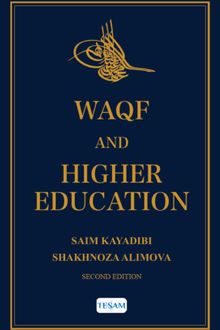
This book brings together the insights and experiences of researchers on Türkiye and Malaysia concerning higher education, examining the subject from multiple perspectives for the benefit of the reader. The profound influence of foundations (waqf) on the economic and social spheres of the Turkish and broader Islamic world underscores the need for renewed scholarly inquiry. Throughout history, Turks have embodied all dimensions of waqf culture within the empires they established, refining and advancing the institutional framework inherited from the Islamic tradition. The Seljuks and Ottomans, in particular, attached great importance to the establishment of madrasas and to the educational activities carried out within these institutions. Sultans, viziers, scholars, court officials, and ordinary citizens founded numerous educational institutions whose financial sustainability was secured through waqfbased structures. In doing so, they not only preserved but also expanded this institutional legacy across vast territories. In Türkiye’s rich historical experience with foundations, as in many other domains, various waqf-based models offer significant potential for establishing sustainable higher education institutions today. Achieving long-term financial sustainability in higher education increasingly requires the diversification of revenue sources beyond public funding. Malaysia, aiming to reduce its heavy dependence on government resources, has initiated several reforms and is exploring ways to harness
the potential of foundations in the higher education sector. In this regard, Türkiye’s diverse foundation models and accumulated institutional experience provide valuable examples for Malaysia’s ongoing efforts