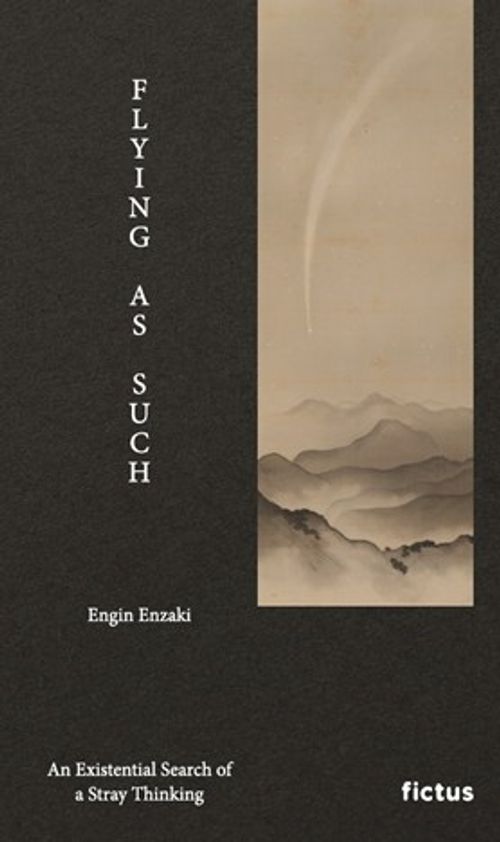
The origin of this work can be traced to an encounter with the painting Comet [彗星] by Yokoyama Taikan [横山大観], which now also appears on the cover of this book. Although the painting readily presents itself as an object of aesthetic contemplation –one in which the gaze may linger indefinitely– what unsettles most in this painting is not its appeal, but the indeterminacy it sustains. The comet’s trajectory resists fixation: it appears, at once, to be falling toward the earth and to be passing through the sky. The perspective and painterly execution suspend the viewer in a state of irresolution, such that one cannot decide whether the comet is on the verge of impact, descending beyond the distant mountains; or whether it is, being in outer space, just continuing its silent passage through the sky. This indeterminacy first leads the viewer to consider the distinctions one imposes upon celestial phenomena (such as comets, meteors, asteroids, “shooting stars” etc.), and the tendency to determine what is, in experience, ambiguous. Yet this classificatory impulse soon gives way to more disquieting questions: what, in fact, in a phenomenological sense, distinguishes falling from flying? Is flying experienced and apprehended only retrospectively, dialectically and relatively throughout the phenomenality of falling? At this point, the examination deals with the state that, to ask what flying is, then, might not be merely to define a movement, but to confront the limits of human horizon to ascribe meaning to it, especially when the ascent and descent lose their dialectic and oppositional positions. What is flying, indeed, if it cannot be disentangled from the occasion (or chance) of falling? What can ascent truly be, if it always already contains the possibility of descent? These questions gradually open onto a more fundamental inquiry: whether flying is ever given as such, or to be more precise, what flying as such is. The questioning towards the flying as such therefore relays to the philosophical problem of as such. While thoughts of thinkers (such as Heidegger, Derrida, Marion and Deleuze) relevant to this problematic are indirectly referred here, the inquiry embraced in this search takes an existential turn regarding the problem of as such and shows that how the as such is not merely a phenomenological necessity, an ontological-transcendental condition, or an immanent givenness, but rather, maybe even more so, an existential event at first. In this event, the flying as such happens only when it is between happening and not happening, to be more precise, only when it brings a sense of its own impossibility along with itself. In this sense, the flying as such is possible only when it is unable to construct an as such (and/or an essence) for itself. This necessitates the inevitable acceptance that the tension between flying and falling can’t be reconciled, neither phenomenologically nor existentially. Or can it be? The text before you is the outcome of this very attempt.